New, Innovative Approaches to Dust Control Needed at Owens Lake, Report Says
News Release
Last update February 26, 2020
WASHINGTON – A new report from the National Academies of Sciences, Engineering, and Medicine finds new and innovative approaches to dust control are needed at Owens Lake, California, to improve air quality, reduce water use, and preserve habitats.
Effectiveness and Impacts of Dust Control Measures for Owens Lake says while much progress has been made in improving air quality through dust control, none of the dust control methods currently in use at the lake meet the mandated levels of air quality while also addressing concerns about water use and environment. Existing dust control measures are dominated by methods that use large amounts of water, such as shallow flooding. The report recommends future research examine individual and hybrid dust control methods and develop new approaches for planning and evaluating the use of those methods.
Owens Lake used to cover about 100 square miles, until water was diverted from the Owens River in 1913 to bring water to the city of Los Angeles. The diversion caused large portions of the lake bed to dry out, and today it covers less than one-third of its former area. Before dust controls were implemented, the exposed lakebed produced large amounts of dust under high winds, resulting in the highest concentrations anywhere in the U.S. of airborne PM10, or particulate matter with a diameter of 10 micrometers or less.
The Los Angeles Department of Water and Power (LADWP) has spent $2.1 billion on dust control efforts as of May 2019, mostly in the form of shallow flooding of the lake, which is used on about 62 percent of the dust control areas on the lakebed. In a 2014 stipulated judgment, LADWP and the Great Basin Unified Air Pollution Control District (GBUAPCD) agreed to rely less on shallow flooding for dust control and to investigate new, refined methods that reduce water use. The stipulated judgment also directed that the National Academies evaluate the effectiveness of alternative dust control efforts, taking water use, cost, reliability, durability, and environmental impacts into account.
“Much progress has already been made in controlling dust at Owens Lake,” said David Allen, director of the Center for Energy and Environmental Resources at the University of Texas at Austin, and chair of the panel that wrote the report. “However, our report finds that Owens Lake needs innovative solutions that not only control dust to meet air quality standards but use less water and meet the needs of the local environment as well.”
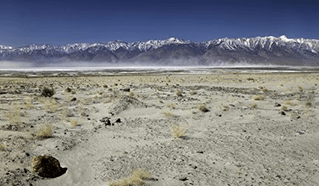
The report emphasizes that dust control methods used at a variety of locations on the lakebed should be evaluated using a systems approach, assessing their ability to improve air quality and their positioning — considering proximity to groundwater, salinity, habitats, and water savings potential. Management decisions should take the value and abundance of diverse ecosystems into consideration, such as the lake’s shallow flooding areas that attract migratory and nesting birds or the alkaline meadows created by vegetated dust control measures. Local tribes have expressed concerns about the potential damage to valued cultural resources on the Owens Lake bed — caused by the use of heavy machinery and leveling operations that come with some dust control measures — and preservation of the natural landscape. The report says that a systems approach can best address the multiple goals of dust control and concerns about its impact.
GBUAPCD and LADWP should develop and deploy new methods to assess PM10 emissions from individual dust control areas, supplementing the current monitoring network, the report says. Moving forward, performance of dust control measures should be more directly linked to PM10 emissions, as opposed to surrogate metrics like percentage of land covered by vegetation. This would enable the use of more innovative and adaptive strategies for dust control.
The study — undertaken by the Owens Lake Scientific Advisory Panel — was sponsored by Great Basin Unified Air Pollution Control District and the Los Angeles Department of Water and Power. The National Academies are private, nonprofit institutions that provide independent, objective analysis and advice to the nation to solve complex problems and inform public policy decisions related to science, technology, and medicine. They operate under an 1863 congressional charter to the National Academy of Sciences, signed by President Lincoln.
Contact:
Megan Lowry, Media Relations Officer
Office of News and Public Information
202-334-2138; e-mail news@nas.edu
Featured Publication
Effectiveness and Impacts of Dust Control Measures for Owens Lake
Consensus Study Report
·2020
During the 20th century, the city of Los Angeles diverted surface water flowing into Owens Lake for water supply, transforming the large, closed-basin, saline lake into a small brine pool surrounded by dry playa. Under high winds, the exposed lakebed produced large amounts of airborne dust, resultin...
View details
More like this




Discover
Events
Right Now & Next Up
Stay in the loop with can’t-miss sessions, live events, and activities happening over the next two days.
NAS Building Guided Tours Available!
Participate in a one-hour guided tour of the historic National Academy of Sciences building, highlighting its distinctive architecture, renowned artwork, and the intersection of art, science, and culture.